(A Vintage post transferred from my old blog)
I am visiting family and friends in Pennsylvania this weekend, and thus I am three hours from my sewing. But I do have a few hours down-time so I thought I'd take some time to expound on one of my favorite fashion-shopping weeknesses: vintage patterns.
It started last year when I was in "50s mode" making my own bombshell wedding dress.
 You see, I got so excited about it the era and the shortage of good repro patterns, that I started cruising eBay for vintage patterns. And lo and behold, they are abundant on eBay. When I discovered the "Collectibles-->Sewing-->1930 to now" category, I was one excited little seamstress.
 They range widely in price, from $2 to $30 or even as high as $80. My own personal price limit is about $8 apiece (plus shipping), unless I am in love with something specific and hard-to-find. 50s bathing suit patterns, for instance, have such a high rate of competition that I think I paid $20 for mine.
When I started out buying these patterns, I bought almost indescriminately. As long as I liked the pattern, and the seller thought all the pieces were there, I would place a bid. I bought a heap of patterns this way, until I have almost filled the top drawer of my filing cabinet (please, no one even hint to my husband how much money I spent on them. He doesn't need to know).
After my initial lust for vintage patterns was sated, I began spending a little more time taking stock and building some criteria. I had bought some good patterns, but now I could be a little more picky. After thinking about it quite a lot, I learned to look at a few things when it came to getting the most out of my purchase.
Size: This didn't start out as being very important to me. After all, I can re-draft just about anything, right? Well, yes, but it does save time (and I have come to look at my time as begin worth money) not to have to size everything up or down accordingly. Many vintage patterns are tiny. I assume this is because the larger patterns got used, abused, and thrown away. As a historian, I have to shout it, people were not smaller back then! Remember, this is your mom's or maybe your grandmother's generation. If we as a species grew at the fast a rate, our grand children would be about 6-7 feet tall-- and that's the women!
Maybe we were a little less chubby on the whole in 1948, but size 32" bust can never have been the norm. For whatever reason, these tiny little patterns seem to be what has survived, and you should take a moment to look before you buy. Sizing up from a 32" bust to a 36" might not be hard. But going from a 32" to a 44" might be a bit more dicey.
Silhoutte: This is easy to recognize. Are you buying 30s, 40s, 50s, 60s? What is a little more important if you are buying a bunch of patterns is that you not buy a bunch of the same thing. In my search for the iconic 50s New Look day dress, I bought about 4 patterns whose main difference was just in manufacturer and the picture on the cover. Duh.


Except for the scalloped neckline on the one on the left, these two are essentially the same dress. Same bust and waist darts, same circle skirt on a round waist. Once you've got a few basic patterns, you might start looking for unusual details that you don't think you can draft yourself.
Think about this one instead. It's got a gored skirt, halter neck, and a great wrap-around button detail.

If you find yourself intrigued by just different the fabrics or minor details pictured on the front of the pattern, save an image of it in your computer and try to replicate it using the pattern you already have.
Condition: This will matter to you differently depending on how much of a collector you are. I don't care if the envelope is torn, provided all the pieces are there. But to some people, it does. Are there water stains? Are the pieces inside all chopped up? Be sure to read the description carefully.
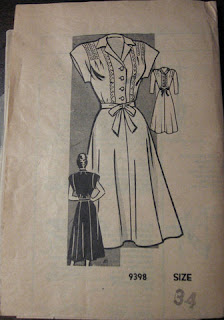 Mail Order Patterns: These babies have quickly risen to become my favorites. Mail order patterns appear (from my very minimal research) to have been popular up until about the 60s, and have petered out through the 1970s. Most often they are highly wearable styles. The packaging also is drawn in really easy-to-interpret style so you can generally get a very good idea of how the garment will fit. Mail order patterns cover everything from evening gowns to underwear, and they often are priced a little cheaper than the fancy-shcmancy Butterick or Advance patterns.
Unusual or Hard-to-Find Patterns: I already mentioned my quest for a bathing suit. That was an ordeal! I was out-bid about a dozen times before I finally won one. And even then, I had to watch it until the very end so that no one bid-Snyped it out from under me (bastards).
 Most of us have a few iconic images in our head that we are conjuring up with these patterns: Marylin Monroe over the air vent or in a pink wiggle dress singing "Diamonds Are a Girl's Best Friend." But there are lots of special occasion looks and even daily-wear items that be vintage and still surprising.
Play suits, slips, bathing suits, aprons, and even bath robes can all make good additions to your vintage wardrobe, especially if you have the creative knack to work them in properly. Don't dismiss something just because it doesn't look like what you remember seeing in a movie! There are a lot of nifty patterns floating around out there that are just waiting to be turned into something fabulous!
 Twentieth century stuff makes me nervous. I can't help it. It's just not my comfort zone.
 I picked a bright floral fabric because damn it all, if it's your birthday, people should notice you! Of course, with this pattern, I also had to use a lightweight, drapey fabric, which gives hives of anxiety just thinking about it shifting around under my presser foot.


